The great thing about travelling to New York is that you're not really in America. It's historically one of the most liberal regions in the country, and New Yorkers will tend to introduce themselves as such, not as Americans. The various boroughs and neighbourhoods of the city are so delineated they're like individual states within a small country. Small in size only, though - if New York were its own country, in terms of population it would be in the top 60 countries in the world, just behind Sri Lanka and only a few spots below Australia.
So, in travelling to New York, we weren't expecting to experience the worst of American cuisine too frequently: overlarge meals with melon-sized baked potatoes oozing over half a cow, while cheese the consistency of clingfilm tries, and fails, to melt, all washed down with a soda the size of a petrol tank. By and large, we experienced excellent modern food in New York, but we did hit up against the occasional American classic.
If you've read any American kids' books you know that they love a peanut butter and jelly sandwich. One of the great secrets of childhood is that they don't mean jelly, but jam! Who'd have thunk? And who'd have thunk it'd be so darn good? No wonder they're all eating it: At Bagel Express, you pick from a dozen or so types of bagel, and, alongside all manner of fillings, are about 20 'spreads and smears' (the latter of which is never comforting to ask for!). I ordered this spread on a whim as soon as I saw it on the list, and it works better than you might think - but check out how much there is! I couldn't get my tongue off the roof of my mouth for hours :)
When it comes to bagels, my favourite bagel shop name was in Boston - Finagle-A-Bagel. I love it because a) it rhymes, b) 'finagle' is such an awesome word to say and c) to finagle is to get something by deception, which seems an unlikely, but kind of charming, choice of name for a shop!
One thing we didn't get in America at all was enormous serving sizes. Part of the confusion around that may be that America inexplicably uses the word 'entree' in place of main, as on this menu from Russell House Tavern in Boston. An 18oz ribeye steak is not a 'beginning' to a meal in anyone's book (except maybe Elvis'. And, to digress momentarily, has anyone else noticed the Elvis sandwich, with some variation on peanut butter, bacon and bread cropping up around town? Auction Rooms, Red Door, Bluebird Espresso...). We did sample said steak, however:
 along with the seared arctic char, a fish whose texture falls in between trout and salmon:
Actually, I tell a lie. There was one meal that involved an unbelievably large serving size. Carnegie Deli is one of those places I knew about, and put on my to-do list, without having any idea how or where I'd heard about it. Finding ourselves peckish for lunch on the way to Central Park, it seemed serendipitous to divert a couple of blocks to grab a pastrami on rye.
If you know what you're in for, I'm sure Carnegie is easy. I didn't, and felt as out of my depth as if I were ordering in a Hebrew-only restaurant. What I came out with was $17.37 less cash, and this behemoth: I made so many attempts at making a dent in this thing, but given it was impossible to pick up and eat like a sandwich from your lap, I essentially just picked at pastrami all afternoon. And I've gotta say, it was fucking good pastrami.
Easily the worst meal we had in the States was at Bill's Bar and Burger, at the Rockefeller Plaza. Other than said lunch, it was undoubtedly one of the best days of the trip, with a trip to MoMa in the morning, extended views from Top of the Rock, and dinner at Babbo that night. The burger was in fact so bad that it was almost cool to have experienced it.
It is many years since I've eaten anything prepared under the golden arches, but it turns out the taste of a McDonalds burger stays with you even longer than the trans fat, and this sandwich took me right back. Sweet bun, grotty patty, and just look at the cheese, which looks more like yellow cling film than a dairy product. Thanks for the extra pickle, by the way - something about a balanced meal?
If that hasn't turned your stomach enough, check this out: On the Amtrak train from New York to Montreal, the dining car offered 'fresh' sandwiches. Pictured above is the ham and cheese version, and this is the ingredient list:
Luckily the views and seating made up for the shortfalls in food on offer.
20 June, 2011
New York - American classics


New York - food shopping
Travelling in America for the first time is like experiencing a walk-through guidebook that explains references from TV shows and movies. Not that I saw a Twinkie while I was there...I still don't know what that is. Or the joy of Pottery Barn. But I did have graham crackers sprinkled over a frozen yoghurt.
Seeing Whole Foods supermarkets put me in mind of Reality Bites: (Lelaina to Troy): 'Oh Troy, that'll never happen. They would never hire you at Whole Foods!'.
In general, I love visiting supermarkets overseas, and at least in this case everything was in English so I could actually read what all the products were. That didn't make the shopping experience any less surprising, however. The Whole Foods is an interesting beast - it promises sustainability and commitment to quality, local produce. Which is great, except that the place is enormous, with every department on a scale that seems entirely at odds with their professed philosophy.
America is full of contradictions like that. For a country battling massive obesity problems, they're incredibly open about what is in their foods, and quite calorie obsessed. Of course, there are two problems there: knowing what's in your food means nothing if you don't know what you should be avoiding, and calories are far from the most important thing to consider in ensuring you're eating healthily.
To give an inkling of the Whole Foods, here is merely their mushroom selection: Over a dozen types and, in the bottom left of the picture is their egg range - not just chicken, but quail and duck too.
Alongside a riotously colourful fresh produce section, complete with a map of local ingredients, they had pre-chopped vegies - both individual and mixed - available to buy by weight. Similarly, at the Granola Bar you could weigh out all your preferred muesli options to combine at home. The serve-and-weigh bars kept coming: salad, hot desserts, hot breakfast, They even had jars of egg white and pre-boiled eggs.
For the vegans, how about some Cluckphrey Chic-a-Roo chicken nuggets, that, of course, aren't chicken, although they manage to look and sound as scary as a McNugget!
The more-is-better theme so amply demonstrated by the mushrooms at Whole Foods continued in our food shopping. A place very high up on my to-go list was Eataly, Mario Batali's Italian food emporium. I knew it was big - Batali is a chef with an empire of 16 restaurants, bars and shops in at least three states - but I didn't know it was going to be massive. Think of the Mediterrenean Wholesalers, but bigger, flashier and full of tourists and Upper West Siders. Eataly has a coffee bar, confectionery section, meat counter, deli, pizza bar, fresh produce, a birreria, fresh pasta...even a manifesto.
Coming from a suburb where often the smallest and least showy cafes have the best reputation, it took some time to adjust to the city that came up with the Bigger is Better idea.
We also ate at Batali's flagship restaurant, Babbo. That was an experience filled with its own flamboyance. More on that to come...
We also sourced a meal from Chelsea Market. It's right next to the Highline, and a great way to spend a warm New York evening is to devour food from the former while people-watching on the latter. Our dinner came from Buon Italia, who served up Italian meals and cooked vegetables by weight. Note to travellers: remember that pounds and kilograms are not equivalent amounts! $14.99 a kilo is fine for slices of parmigiana, cooked mushrooms etc, but when it's actually $14.99 a pound that makes it $40 a kilo, which is getting into current banana-price territory :)
And one quick food-shopping find: Burdick Chocolate on East 20th St, just off 5th Avenue a few blocks down from Eataly, does these adorable individual chocolate penguins and mice. They come boxed singly, or in groups, and let's face it, are way too cute to eat!
19 June, 2011
New York - brunch
They love to brunch in New York. And when I say brunch, I mean something more than just a snazzy word combination to describe a mid-morning meal, something more than ordering off the breakfast menu late in the day.
Most cafes have a completely separate brunch menu, available only at set times on the weekend, normally something like 11-4. In most cases, the menu also covers cocktails - often one (or more) is included along with your meal. It's a dining tradition I'm quite keen on and its absence on these shores is leaving my Sundays feeling a little bland and disappointing in comparison.
The only frustrating thing about New York's winning brunch arrangements is that they're only available on weekends - even as happy-go-lucky tourists you can't take advantage of a quiet Thursday to knock back a few complimentary bloody marys with your poached eggs. So, when it came to the weekend, brunch was our priority tourist destination. Within 36 hours of landing in New York, we'd been to Brooklyn twice. Our initial, jetlag-avoiding meander south from Houston Street led us to City Square, site of the striking Municipal Building and start of the Brooklyn Bridge. Never one to let debilitating tiredness and crazed melatonin levels get in the way of a travel opportunity, we duly crossed said bridge, and found ourselves incapable of much more than an atrophied rest in the Brooklyn Bridge Park. Even the attractions of a Calexico cart couldn't lure us to our first sample of street food.
The next day we crossed the river again, via subway this time, to hit the Brooklyn Flea Market,  featuring the Smorgasburg food market. I held myself to a doughnut at the markets, however. As Brooklyn is gentrified by up-and-comers escaping the $800K median apartment price tag in Manhattan, it's embracing the cafe culture big time, and I had a whole list of possible places to brunch at.
One was Milk Bar, famous in these parts for having an Australian, indeed Melbournian, barista, who can make a 'proper' latte. Seems the Americans are loving it Aussie style too - the place was pumping full when we went past.
Instead we trudged (jetlag and heat don't really put a spring in your step) an extra couple of blocks to The Spot, home of the unlimited mimosa brunch. That's right - you promise to pay them $12.95 and in return you can pick anything off the menu and they will refill your glass with bubbles and orange juice as much as you like. Rather than the hiss of the coffee machine, this cafe resonated with popping corks.
The thing was, we were both ragged with jetlag, and unlimited drinks coupled with fatty food on a hot day was probably a recipe for....well, indulging in the crazy, nonsensical kind of things you do on holidays, really.
So, SG went a safe option with the pancakes, for which the customer could choose their own filling, his taste running to strawberry and blueberry. The great North American condiment, real maple syrup, came jugged on the side.
Without elaborating, the waiter advised that the 'French toast Spot style' was pretty special. I figured, when in Rome, and all that, and ordered according to his recommendation.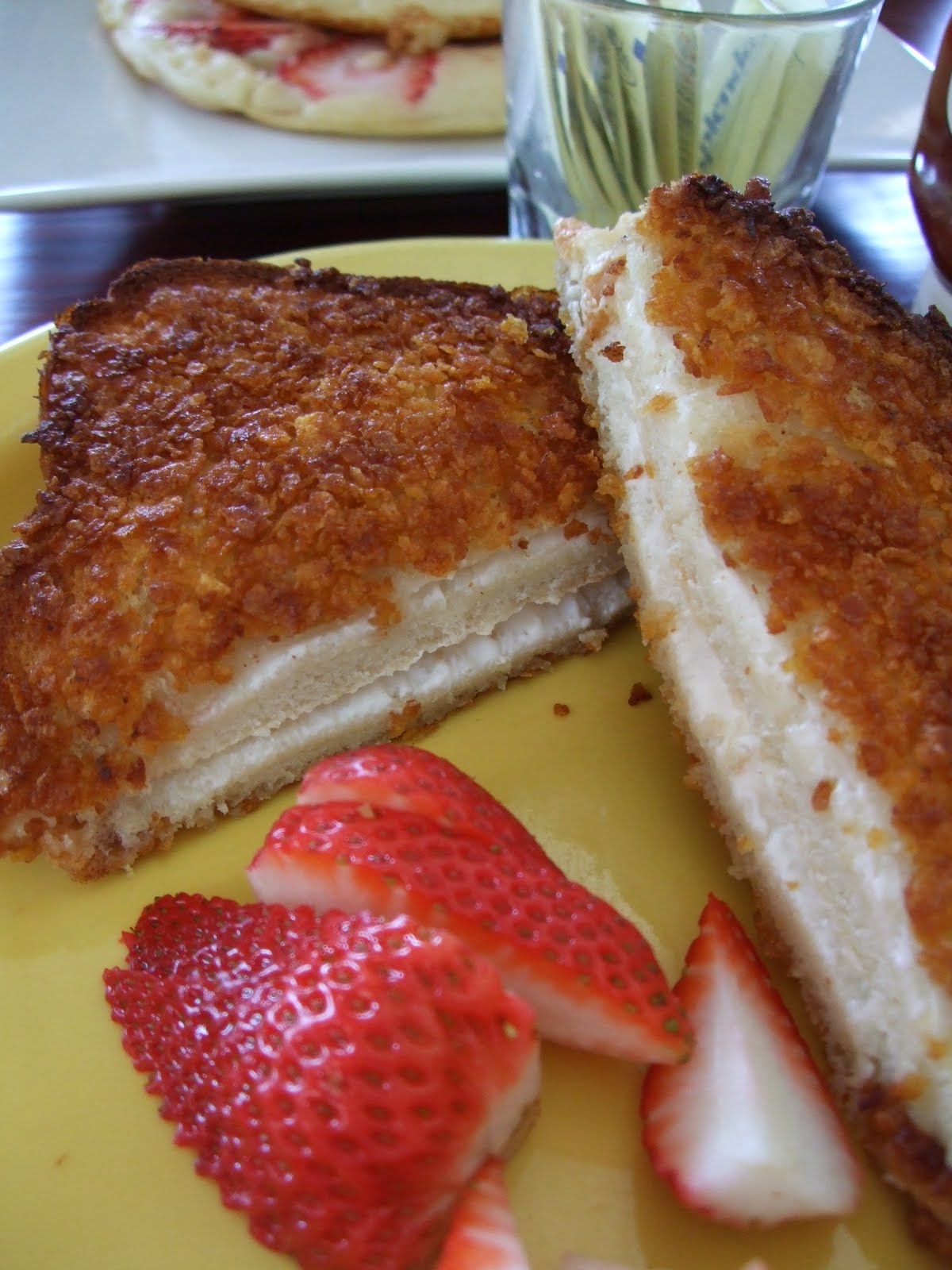 Thank you, I will have my French toast deep-fried. The special addition was the cream cheese on the inside. It really wasn't that bad, and let's face it, we were drinking all the sparkling wine we wanted for the price of a sandwich at Earl, so there wasn't much to complain about.
To celebrate this, our first New York brunch, and to recover from imbibing alcohol and ingesting plenty of fat, sugar and dairy midday, we promptly went home and went to sleep :)
The next day we went back for more, this time keeping it much closer to home, needing only to trudge four doors down from our apartment to Jane. This was a fancier place than The Spot, overrun with good-looking Villagers. We perched at the bar, and spent as long picking a complimentary cocktail (raspberry champagne) as the food. Here we have corn 'pancakes' (the discs sitting under the eggs), topped with perfectly poached eggs, maple chicken sausage and tomato hollandaise. Alongside are the home fries (it took us a while to hit upon genuine fries, rather than wedges). The maple sausage in particular was delicious. I love maple syrup in baked beans, and discovered in America what wonders it can do for meat as well.
Prune came to our attention via a friend's recommendation. It's in an unassuming street in the East Village, and I think exemplifies New York's weekend dining scene. Rammed inside, anxious groups hovered outside, awaiting and cursing missing friends who prevented them from being seated. The hostess ran the show with authority, in some cases seeming to fit people in at whim. The cafe's popularity was proven by diners who arrived unfazed by the prospect of a 40-minute wait. We were seated within a couple of minutes (must have been of those hostess whim things). I'd been after something straightforward - a toast and scramble kind of thing, with cocktails, of course. The menu didn't present as straightforward, and it soon became clear that this was a cafe that took brunch very seriously. They've nailed the idea of a mix of sweet and savoury dishes - often both elements on the one plate - to fill the late-morning to early-afternoon eating requirements of cashed-up kids on the weekend.
Our choices were thus: Dutch-style pancake, with blueberries and coulis, served with sour cream and Canadian maple bacon. This was so delicious. The pancake was risen in the oven, rather than a pan, and it was like sitting down to a sponge cake for breakfast. The blueberries soaked right in, and offset by the salty, smoky bacon, it was just divine.
 This was on the menu simply as 'spicy chickpea stew', but it was so much more. The (not very spicy) chickpea and tomato stew does form the basis, but sitting atop are two wonderful things: crumbed poached eggs, which held their runniness throughout the meal. Astride the plate are two pieces of flatbread, spread with the most decadently salty olive butter. I'd have paid the price of admission just for that.
So much for scramble on toast!
New York - pizza
I'm sometimes surprised at how habitually SG and I eat pizza when we're away. We make it and/or order it at least once a week when we're at home but even so, whenever we're travelling, it comes up on the food menu pretty quickly.
We tried three pizzas in New York. We started on our first night, languishing under the burden of jetlag and envying the rest of the city their enthusiasm for Friday night. We ate at Benito II, in Little Italy. It was hardly a little out-of-the-way find, but walking was tough enough, let alone hunting down and discerning between restaurants.
We got their primavera pizza, offering seasonal vegetables, which turned out to be broccoli, mushrooms, and beans. Green beans. Not a toppping I'd seen on a pizza before. The topping choices were weird, but the base and the overall dish were fine. The base was thicker and crispier than we're used to, and quite biscuity.
Two Boots pizza was a food option I'd noted from a random article in the New York Times I'd read months before eating. We came across an outlet in the food court beneath Grand Central Terminal, and a slice each provided the perfect snack/dinner before heading for a late-night visit to the Empire State Building. This is their pepperoni and mushroom pizza, and for ready-sliced pizza in a public transport food court it was pretty darn good. Much more in the thinner, floppy-base style than the other pizzas we tried while away. Two Boots are all over the city - worth checking on the basis of this sample.
Across Thompson St from our apartment was Arturo's, clearly something of a Greenwich Village institution. Customers spilled out to the sidewalk tables every night, and the sounds of live music and carousing from the inside bar and restaurant slipped through the door with the constant coming and goings. A New York ingenue, who could have been anything from 16 to 30, perched on a railing outside the door and guided customers to their preferred type of table with precision - heavens forfend another staffer seat anyone or bring them menus.
Their pizzas, despite our hostess' assertions that they were the 'best in Manhattan', really weren't that good, to my taste. They weren't bad, they were just in that older, thicker-based style that doesn't get served up in many pizzerias or trattorias round these parts. The meat didn't seem to be anything special, the cheese was just cheese (though not as oily as you get out here, at least). They're big on the coal-fired oven over there, and I don't know if that's imparting less distinction to the dough and toppings.
What was most notable about our meal at Arturo's was the arrival of this fire engine. It clanged past, then braked and deadset reverse parked right in front of the restaurant. It made enough noise that the boutique-dressed and coiffed lady next to us, who hadn't disengaged from her iPhone to talk to her partner or partake in ordering food, had to head round the corner to continue her conversation. Six firies jumped down from the truck and headed in for a slice of pie.
26 September, 2009
Italy II and Spain I: Cured meats
We established early on that this was going to be a meatlovers' tour of Europe. In some of the towns we travelled to it was just as well: in Sanabria in Spain, for example, most menus offered a choice of how your beef was cooked, and not much more.
More than fillets and steak, however, what really stood out were the cured meats. Our trip itinerary read: Budapest, northern Italy (including Emilia-Romagna), north-western Spain. Looking at those three destinations, three things that immediately come to mind are: salami, prosciutto and jamon.
On the proscuitto front, we were in for a real treat. Other than a dogleg as you near the coast, Ravenna lies in a straight line on the far side of Emilia-Romagna from Parma - home to one of the finest cuts of Italian ham. We stayed at Hotel Centrale Byron, where their 5 euro breakfast featured some of the best crudo we ate on the trip.
That's what is so gorgeous about travelling and eating in Europe. Locavorism isn't an 'ism' over there, it's just the obvious way to do things.
We tried two meat platters around the restaurants of Ravenna, one so divine we went back for it again. Here's Nonna Ayeska's: Proscuitto crudo in the foreground, then (going clockwise) coppa di testa (head cheese), mortadella, piadina, squacquerone, salumi, ciccioli a fette. On the second night, the dish became - implausibly - even better with the addition of some onion jam.
Nonna Ayeska also served up this extraordinary plate of bresaola (for a starter!) The decadent meat slices are topped by equally thin strips of parmagiano and green apple, then dribbled with sultanas and nuts. Just astonishing.
At La Gardela their plate of tagliare buongustao (local cut meats) was differentiated from Ayeska's with the more traditional style ciccioli frolli. Ciccioli is made from leftover pieces of pork, and the frolli style is crunchy, like the ultimate version of pork crackling.
Piadina is the local bread in Ravenna, and perhaps the best value lunch I had while overseas was from the piadineria across the road from our hotel: a fold of the thick, flat, chewy bread clamped around proscuitto crudo and provolone, for 3 euros.
Once we got to Spain, I could have subsisted for the week on my all-time favourite food: fresh Spanish bread laden with jamon serrano.
Sure we pay $60-$100 a kilo for the good stuff here in Australia, but in Spain they don't skimp as they cut straight from a leg on the counter. This is a bocadillo served up in a random bar in Salamanca:
The best cured meat sandwich came from a still-warm breadstick bought in the northern fishing village of Cudillero, filled with serrano bought from a deli in Oviedo, and eaten by a stream gurgling towards the Picos de Europas, in the shadow of this medieval bridge.
In Sanabria, while I moaned over the greatest plate of morcilla ever served, SG was in similar raptures over an enormous serving of lacòn de cerdo con pimientos del piquillo - cured pork with red peppers. In homage to our regular enjoyment of the cured stuff while we were overseas, we've been pursuing the best purveyors of cured meats around Melbourne. For jamon, you can't go past Casa Iberica in Johnston St. For proscuitto, our current fave is the $60/kg import from the deli in Northcote Plaza. Note that most good delis stock imported and locally cured meats. Often the former are preservative free.
Italy I: Pasta
Our Italy trip was no more pasta laden than an average week of eating in Melbourne. Our attention was far more diverted by cured meats and delicacies, both savoury and sweet, from street-side shops. Pasta undoubtedly deserves its own mention, however, particularly since it formed part of some very worthwhile dining experiences.
 Ristorante Vecchio Falconiere in Padova looked like a great find. Accessed via a flowered bridge across a canal, it offered al fresco dining from a menu that promised reasonably priced pastas or, if we felt like going a little crazy, affordable, meaty mains.
But things aren't always as they seem. Rather than menus, our ebullient host brought a tray of pasta models to the table, and talked us through what was on offer, including the blueberry ravioli, or a mixed pasta plate if we liked (mixed entrees maybe, but what were they going to do? Bring it out on a dip tray?). Then, he drew up to his full height, puffed out his chest and said 'For main, I offer you my speciality. All the cuts of horse, cooked for you at the table.'
Call us staid, but we decided to stick with a la carte. We were rewarded for our lack of adventurous spirit, however. First up, the fusilli con cinghiale (wild boar, or wild pork as our host insisted).
This wasn't just any wild boar, but instead the cinta senese, a rare and ancient Tuscan pig represented in writings and art from the 14th century. (Good cured meat lasts a while, but I assume ours rummaged in the fields around Greve rather more recently than that.)
Fusilli in Australia, when bought as dried pasta, is normally shaped as a swirl. Freshly made, Italian fusilli, however, as you can see looks much more like someone took a length of pasta and rolled it over the table. Its curves were perfect for capturing the unctious ragu.
We also loved the tagliatelle con funghi misto, a dish of of rich, earthy variety.
 Our favourite restaurant discovery of the trip was Ristorante Nonna Ayeska in Ravenna, the main reasons for which will be elucidated in a coming post on cured meats. Their pasta was nothing to complain about either. The restaurant specialised in the local style of filled pasta, cappelletti, or little hats. These came con ragu or, as below, con vellutata di carciofi.
 'Vellutata' literally means velvety, and I think it's a wonderful term to apply to the mush of artichoke that clung to the cheese-filled pasta.
A sauce of salsicce e piselli (sausage and peas), tried on different visits with both gnocchi and strichetti, was delicious, but lessened by the fact that the peas had been cooked in highly salted water, and that saltiness dominated the dish.
Strichetti is Emilia-Romagna's version of farfalle, and looks more like Chicken-in-a-Biscuit than bowties!
At Trattoria da Paccagnella in Padova we sampled some of the Veneto's favoured pastas. Most restaurants feature bigoli, a type of enlarged spaghetti, eaten here con sugo di gallina imbriaga, 'gallina' referring specifically to hen. The sugo, fittingly enough, tasted precisely like chicken soup.
It was one of our last nights in Italy and I excitedly devoured a plate of strigoli con salsa di basilico. There are few greater pleasures than fresh pasta smothered in a zinging basil sauce (and all the better when it comes with garlic wedges like this!).
 The best food photo of the trip goes to SG's choice at Paccagnella:
 Ragu di vitello in bianco e fiori di zucca (twisted pasta in veal and white wine sauce with zucchini flowers).
At Paccagnella, house wine comes to the table in a bottle, and diners pay for a quarter, half or full bottle depending on how much they've drunk.
16 September, 2009
Budapest III: Take away?
Here we have schnitzel, Budapest-style. Note that the side-dish of veg was ordered separately; otherwise it's just a schnitzel with its own postcode on a plate. When we'd conquered as much of our dishes as jetlag and their richness allowed, the waiter asked if we'd like them taken away. We replied in the affirmative and he came back a few minutes later with the schnitzel and remaining vegetables neatly packed up to take-away :)
It was just as well he did. We got another two meals out of the schnitzel, and the fairly robust plastic container he provided for the vegetables later gave passage to a rather exquisite apricot-jam-filled doughnut (from the bakery across from our apartment) for the overnight train trip from Budapest to Italy, and later to some flavour-bursting strawberries from Ravenna's covered market on a daytrip to the beach.
The schnitzel was part of dinner on our first night. The restaurant, Bécsiszelet, offered glasses of wine for 300 forint (ft), which equals about $AUD2. Not bad. Turns out, however, that the wine price quoted on a menu is for a set amount, perhaps 100ml or so. Hence, our generously sized glassed were in fact 600 ft. This was standard practice in most places we ate. Another few words on Budapest's culinary nomenclature. Before leaving on this trip I'd discussed with a friend the difference in Australia between a cafe and a restaurant. We didn't arrive at a definitive answer. In Budapest, however, each type of venue is clearly delineated from others.
A kávéháv is a coffee house, a simple cafe serving m ainly hot drinks. A cukrászda is a step up, serving cakes, pastries, strudel in addition to coffee. When it comes to drinking alcohol, a söröző is probably closest to our pub, whereas a borozó is more of a bar (of the games machine type). A restaurant might be a vendéglő - as were most that we ate at - or an étkezdék, probably what we'd call a cafeteria. And don't forget the Kinabufe: Chinese food served from a buffet. We didn't broach trying to decipher 'sweet and sour pork' in Hungarian!
14 September, 2009
Budapest II: Stuffed
 Hungarians are quite keen on stuffed meats, often stuffing them with other meats. Pork and beef are probably their more common choices, with chicken appearing less frequently (and normally with the paprikás sauce, i.e. with sour cream added).
The delightful-looking dish below is from our first night in Budapest. We arrived in Budapest on a Friday, the day after St Stephens Day (and the Red Bull Air Race). The celebration had clearly prompted quite a lengthy celebration, and the majority of eateries in our area were closed, Friday night and all. We had come across an open vegetarian restaurant near our apartment, but its menu consisted mainly of weird things done with cheese, and it didn't quite appeal.
Bécsiszelet proved our saviour, however. Here we have pork, stuffed with clod, bacon, feta and olives, in a dill sauce, with a side of crunchy-melty croquettes. We were intrigued by this 'clod' ingredient, and managed to divine that it's something along the lines of speck.
An enticing, basement-level restaurant near our apartment was closed for St Stephens and in addition chose not to open on Saturday nights for July and August (who'd be out eating on a Saturday in summer?). It was worth the wait, however, for this fine plate of 'Csabai töltött karaj pirított burgonyával, párolt káposztával'. That translates as stuffed pork chop csabai style (i.e., with chorizo - great choice) with saute potatoes and steamed cabbage. (This restaurant, Regős Vendéglő, has their multilingual menu online. $AUD1 = 150 ft.)
It's not just meat the Hungarians enjoy stuffing. They also do a fine line in pancakes. I was in Budapest at the behest of a friend who'd travelled there for a conference and I was able to tag along to the buffet dinner on the conference's last night. One of the desserts was a bainmarie of palacsinta (pancakes) filled with two types of jam and washed in melted chocolate. At a buffet!
We'd already sampled our own version at the delightful Hunyadivendéglő, appropriately smothered in chocolate and chestnut sauce, accompanied by palinka (fruit brandy).
13 September, 2009
Budapest I: The problem with paprika
 It's been all quite on the W&F front for a little while. Recently, that's because I've been in Europe, exploring Budapest; Ravenna and Padova in Italy; and the north-west of Spain.
The trip was three weeks rife with culinary, artistic and visual delights, plenty of which will no doubt find their way up here in the weeks to come.
Where to start? Well, the beginning's not a bad place, which takes us to Budapest. Hungarian food is big on pork, paprika, crumbing and stuffing.
Their food is traditional enough that learning to recognise a few menu staples is a big help in the vendéglős (small restuarants).
Rántott, for example, means deep-fried in breadcrumbs. Here we have a dish delightfully named 'postman's favourite', consisting of crumbed pork stuffed with sausage, onion and bacon (yes, that is three meats in one item).
Pörkölt is a ragu of pork (normally), beef or chicken, coloured bright red by paprika. It's served here with noodles similar to the German spätzle.
Paprika is a complicated word. It can refer to both a spice and a vegetable, the latter also being known as capsicum and pepper. In Hungary they cook a lot with what we call capsicum, often using a white variety, which to look at on the plate is indistinguishable from onion. They're keen enough on paprika the spice for it to be a standard condiment on most restaurant tables.

To add to the paprika confusion, paprikás in Hungary is similar to pörkölt, but sour cream is mixed into the sauce. (Hungarians are keen on sour cream, but not as crazy for it as Estonians.) It's a meat-and-carb kind of place, since you need to mop up all that sauce with something. A side order of veg doesn't go astray either!
Gulyásleves (anglicised to goulash) presents another false friend: in Hungary it relates to beef soup (leves is Hungarian for soup), whereas we think of it as a stew (such as that served at Koliba). What we term goulash is closer to the pörkölt above. This soup was a little light on meat, but what meat it had was delicious. Conversely, it was quite strong on mint, which was a surprise.


