 Food intolerance, or malabsorption, is the scourge of the food lover. In the case of fructose malabsorption (FM), it's a surprisingly sneaky curse. Fructose is a naturally occuring sugar, present in some of the most everyday, innocuous foods that make up fave snacks and meals - who would ever suspect apples and carrots as capable of inflicting digestive problems, tiredness, bad moods?
Conversely, it's also the primary ingredient of one of our most heinous manufactured products - high fructose corn syrup (HFCS), an ingredient variously responsible for the destruction of swathes of variegated farming land (all turned over to monoculture corn production), the homogenisation of groceries (some estimates say about 90% of products in an American supermarket required HFCS at some point in their production), and obesity, since all that fructose in packaged foods is more than our bodies know what to do with. Fructose is processed by the liver, rather than being taken on by muscles to make energy, and what we can't use goes straight to triglycerides, ie fat.
In my neck of the woods, avoiding HFCS isn't that hard. But the list of naturally occurring sources of fructose reads pretty much like my shopping list: garlic, onion, apples, tomato paste, honey, zucchini, artichokes, quince. Some foods are more affecting than others, and for products on the definite no-go list everyone's tolerance is different.
So there's a lot of experimenting going on at the moment. I admit I'm not a dedicated intolerant. Some days I'm content to merely verbalise that I know what I'm eating is high in fructose - the acknowledgement somehow substituting for the avoidance. Last night, for example, I cooked up the first minestrone of the season, replete with a bobbing ham hock. I loaded it with celery - an allowed vegetable - and went easy on the carrot. I didn't think to cut back on mushrooms though (cut into chunks, they're one of my favourite parts), and it wasn't until I was eating it that it occurred to me it of course contained a tin of tomatoes...and pasta (wheat contains fructose).
Today for lunch, however, I think I nailed something acceptable. That Jess Ho mentioned farro, which reminded me of a big tub of pearl barley in my pantry. I'd used some recently in a braise to accompany lamb shanks, something I'd copied from a delicious lunch at De Bortoli's Locale restaurant. I cooked a handful of grain gently in a puddle of stock for about half an hour, then fried up some spinach, with a few pine nuts, and drizzled on lemon olive oil. On top I perched a poached egg.
It was pretty good - could have used some more pep with the spinach, but it was filling, tasty, healthy and fructose free. Here's to more of that.
02 May, 2011
Fructose free


19 March, 2010
Tinning the toms
For some it was a tradition to be endured then ignored; for others it's a logical conclusion to the bounty of summer produce. For me, it's a ceremony just begun, for my own fulfilment.
The idea of chopping, seeding, cooking and canning tomatoes at the end of summer has appealed to me for years. I've read and heard numerous accounts - positive and otherwise - of traditional family days that produced cases of lustrous red sauce. Truth be told, it's a tradition deserving of company, of allocated roles, and a matriarch to direct proceedings.
I didn't even have a tomato plant.
The lack of produce wasn't a problem. All year I'd planned to head to Gateway Estate in Coldstream to pick up one of their 10kg, end-of-season boxes of roma tomatoes, grown on site. Gateway's store is dwarfed by their greenhouse, which is vibrant with capsicum, eggplant and tomato plants. The small retail area is crammed with firm, luscious fruit and vegetables, as well as local preserves, oils and sweets. It's also the cellar door for their own wines. These eggplants, grown on site, were magnificently firm, weighty and glossy:
 While up there we headed to Gruyere, for lunch at the Red Shed Cafe, a thoroughly recommended spot.
Back home, it was time to take a knife to this lot:
 In the course of the day I cooked four batches, each with a slightly different preparation. One decision to make when preparing tomatoes is to skin or not to skin. It's quite fun getting the skins off, but does add time and effort to the process. Aunty Stephy doesn't skin, but she does pass her sauce through a food mill, so she gets rid of them at the end. There's nothing wrong with leaving them on, but obviously you'll end up with a chunkier sauce.
Skinning tomatoes is quite fun, if you have the time and inclination. Cut a shallow cross in the bottom, then drop each tomato into boiling water for 10 seconds. Dunk them in cold water, then peel the skin right off. If you cut them in half after taking them out of the cold water, it's even easier to get the skin off. You're left with something that closer resembles a ball of watermelon:
 Once they're peeled (or as the first step if you're leaving the skins on), cut the top (the calyx end) off the tomatoes, then cut them into quarters. Use a small knife to cut out the core, taking the seeds with it. Discard core and seeds. It can feel like you're getting rid of a lot of tomato, but you keep much more than you throw out. (Leaving the seeds in can make the sauce too bitter).
For each batch I sauteed onion in plenty of olive oil, then added the tomatoes and chopped garlic, along with a dash of red wine vinegar and plenty of dried oregano. That bubbled away to itself in a simmer for 40-60 minutes, before I added some seasoning at the end along with torn basil leaves. After that, it was time for a whizz in a food processor, then an awkward funnelling into recycled, sterilised passata jars.
A note to aspiring saucers: heat is an important part of sterilising. Add hot sauce to hot jars. If you're boiling your filled jars to form a seal, they need quite a while in the hot water (and the 'button' should pull down to indicate it's sealed).
Batch 1 was skin on, so came out a deeper red, and quite chunky. Batch 2 was skin off, and notably smoother. Batch 3 I passed through a 'sieve' (actually just a very fine strainer), creating quite an impressive jar of passata. The skins and extra bits from Batch 3 went in the food processor with Batch 4, making a last lot that stayed in the fridge for use that week.

17 March, 2010
Homesun goodness: sun-dried tomatoes
I tried growing tomatoes last summer. The plants too quickly outgrew their pot (I admit I'd been stingy on their living quarters), and while they tried valiantly to deliver up a couple of red goodies, one couldn't call the first try a success.
Later that summer, I heard Rosa Mitchell, chef at Journal Canteen, talking about making sun-dried tomatoes, something she does every year. Simply put, one cuts the tomatoes in half, removes the seeds, sprinkles them with salt, then lays them out in the sun for a few days.
And it is that simple. For three days I trotted out into the garden every half an hour or so to move them in alignment with the sun. It didn't take too long for the sun's effect to become obvious, the skins to wrinkle and the tomatoes to start to pucker as they dried out.
By the second day the smaller ones looked exactly like...well, the ones you'd buy in a shop. By the third day they'd all shrivelled and darkened, and a quick taste-test revealed they were bursting with concentrated tomato flavour.
This to me is the best kind of 'cooking'. It requires very little skill and even less equipment. What it does need is a good dash of time and a pinch of patience. But these are the ingredients I most like to bring to my food, to create things that use a bit of a nature and that are enhanced by the seasons.
The natural extension of this project was to finally instigate Tomato Day, and evoke my non-existent Mediterranean ancestors in the production of tomato sauce. Read all about it...
17 December, 2008
Bean scene
 Ah, the bean. For three splendid months of the year - normally September to November (though late-onset summer seemed to extend the season this year) - our weekly grocery shop consists of as many broad beans as we can carry, with whatever else we need a secondary pursuit. I eat kilos of the things, loving every moment of preparation and consumption.
Broad beans need to be podded - a joyful process, as peeling open their leathery green skins reveals a delightfully downy interior. Once you've freed the beans, blanch for three minutes, refresh in cold water, then slip the beans out of their skins. Use your thumbnail (or knife) to make a slit, then squeeze, and 'plop'! You're down to the good stuff.
The next step is deciding what to do with your vibrant green pile of legumous loveliness. Here are some of my favourite uses from this season:
Risi e bisi is a favourite dish year round, using frozen peas when the fresh ones are out of season. In spring, however, it takes on a new flavour spectrum with the addition of broad beans. I like to mush half the beans and stir them into the wet rice along with stock, adding the other half whole.
Many moons ago, a kitchen-savvy friend served me dinner of pork fillet with a rosemary, red wine and bacon jus. It remains in the Top 5 home-cooked meals I've had the pleasure to savour. And, as I'm wont to do, a couple of years ago I borrowed the idea and ran with it. Pork cutlets, followed by a preparation of the same jus, often grace our frying pan. Gerald's Bar recently inspired an update to that dish, and our last pair of cutlets came to the plate as braised pork on polenta with broad beans. With a little help from Aunty Stephie (which, by the way, was a gift from the same friend who cooked the original pork dinner), we winged a recipe and a method, and came away quite thrilled with the result.
Polenta featured again in a similar dish with a piece of chicken poached with in a simple broth of bay leaves, onion and seasoning.
They're not just for dinner though, those beans. In a home dish worthy of a cafe, mushed broad beans were spread on toasted bread, topped with homemade baked beans (maple syrup is the trick for great beans) and dotted with feta. A thoroughly fulfilling and pleasurable start to the day.
One Sunday night found me with that heavy feeling of cumulative excess from the weekend. When I thought of dinner, my body responded saying, 'Vegetables, hold the meat and carbs (and preferably the oil and butter'. Well, the only sensible answer there is to steam. Artichokes went in first, followed by some carrot to give them plenty of time to soften up, a few strips of asparagus, and lastly, the beans. I hadn't heard my body prohibit dairy, so feta featured once again. This dish was enormously flavoursome (when you cook in season, rich flavour comes guaranteed), filling enough for two meals, particularly wholesome and served the happy purpose of using up a range of ingredients bought for different meals throughout the week.
The last star dish before the bean bonanza began to wane featured a new meat: goat. Maggie Beer promotes this choice and, like lamb, it's best in spring. Queen Vic Markets have a couple of stockists, including Alec Watson (at the back of the Meat Hall). Even when fresh, it's a bit whoofy, so not a good one to handle if you're at all sensitive to fresh-meat smell. It cooks up a treat though - soft, rich and tender - when set to a slow stew with tomatoes, shallots and herbs. We love India on Lygon's version, but took a Mediterranean route, dishing up capretto al forno.
For now, though, it's time to put the bean steamer back in the cupboard. I do have one trick up my sleeve though - I've made a couple of broad bean dips (with garlic, lemon, a dash of paprika and some sour cream or yoghurt to smooth it out and boost volume) and popped them in the freezer, so I'll be able to sate my broad bean cravings at least a couple of times in the cooler months.
06 August, 2008
Pinching quince
 Quince and I became friends in Spain. I was staying with a friend in Valldolid, and it was brought out for an evening snack. After experiencing its sweetness and dissolving texture (coupled, of course, with a semi-cured cheese) I could but stumble out 'Que es?'. 'Membrillo' was the answer and for the remainder of my stay any hostly query as to whether there was anything I wanted was answered with 'Más membrillo'.
It was sometime after that before I actually saw an example of the fruit, quince. Inspired by its flavour and texture in every form - jam, butter, paste - I resolved to cook some myself this year. Happily the decision to do so coincided with the recent bloggers' meet, at which plenty of attendees could offer advice. Thanks especially to Cindy at where's the beef, for pointing me to KJ's sumptuous photographs and cooking challenges at A Cracking Good Egg. Caroline Velik had also done a spread on quinces in Epicure a few weeks back.
I'm not a meticulous cook, and cut and pasted a process together from these multiple sources. A modest two quinces were quartered and cored, with the pips and cores added (in a muslin bag - I used a crepe bandage!) for the cooking, along with sugar syrup, lemon and vanilla essence. That went, covered, in a casserole dish into the oven, for five hours. To make quince jelly one uses the liquid left after this process, which I did, but sort of ended up with quince toffee (not complaining). In the absence of a food mill I mushed the cut fruit through a sieve (a food processor would probably do the same job more quickly and noisily), then heated it with half its weight in caster sugar, for about 45 minutes over low heat.
According to KJ and Maggie Beer, at this point one should spread the paste on a tray and leave it to dry. What I had tasted right, although it was a little more pink than red, so it went straight to containers:
Perhaps a more inspiring picture from the weekend is this tagine:
Taken from the perennially pertinent Seasonal Produce Diary, it's a dish to warm the room and the soul. Fry onion till soft, add ginger, ground spices, passata, chicken stock and seasoning. Pour over diced blade steak, in a casserole, and bake for 2-2.5 hours. As accompaniment, sliced parsnips were doused with coriander, paprika and cumin, drizzled with olive oil and laid on a tray with some more chicken stock to cook alongside the tagine. Delish.
15 April, 2008
Abendessen bei Katharina
For English, click here
Am Montag hatten wir 'Unterricht' (tatsächlich Abendessen) bei meiner Deutschlehrerin. Alle hatten einen Teller mitzubringen. Wir haben uns ausgezeichnet! An der Spitze hatten wir die Pasteten der Esther, mit Korbis, Kiefernüsse und Fetakase gefüllt. Seit Tagesanbruch aufgestanden, hat sie den Tag in der Küche verbracht, diese lecke Stücke vorzubereiten. Die Müh hat sich gelohnt!
Eva hat mariniertes Huhn mitgebracht, die Jackie brachte Brot mit Lachs oder Fleisch bei. Durch Les hatten wir Quiche. Ich brachte zucchini fritters, die ich am Morgen gekocht hatte. Sie sahen wie nicht so viel aus, so bereitet ich zusätzlich hausgemachte Pestomayonnaise vor. Von Anthony kammen Kreks und dips. Wir hatten auch Salate und damit ein gleichgewichtes Mahl.
Wen habe ich vergessen? Egal, weil alles, was dort war, hat wirklich gut geschmeckt. Hier ist mein gepackter Teller. (Bin ich in Heidelberg, Baden-Würrtemberg; oder Heidelberg, VIC??)
Die Männer versahen Wein (sehr wichtig!) und die Katharina (unsere Lehrerin und Gastgeberin) die Anstrengung, alles kaltes Essen warm zu machen. Sie hat sich auch für Untersetzungen zwischen Tisch und heißer Platten zu liegen gesorgt. Der baldheiratende Robin hat Miles Davis für Musik gewahlt. Leider konnte die Kris nicht dabei sein, aber sie hat, wie immer, ihre Vertreter da geschickt:
 |  |
 Oder noch interessierer: schnell gespinnt
Zusammen verbrachten wir einen echten schönen, zivilisierten Abend.
01 February, 2008
Copycat

28 January, 2008
Australia Day BBQ
Hm, now this is a food and book blog, so it's not the forum for me to discuss my opinions on Australia Day. However I feel that I have to clarify that this was not an 'Australia Day BBQ', rather a BBQ that happened to be held on that day, which was significant and worth naming in order to set the tone - that long weekend vibe that often gives rise to urges to grill. Spectacular weather along with excellent, fresh, well-priced food seemed as good a thing as any about Australia to celebrate.
But to the food. For me, when it comes to barbecueing, I concur that meat is an essential, and that it can be provided from a range of animals and in a range of colours and formations, however what I consider a given on any barbie where I'll be holding the tongs is potatoes. Very finely sliced, liberally oiled and with generous amounts of sea salt and rosemary distributed atop. They're normally my BBQ vegetable staple, but since we were going all out, I even prepared a wee salad, of spinach, red capsicum, snow peas, avocado and cashews.
Something had to balance out the three types of meat! The grill hosted chicken skewers with mushroom and capsicum, beef sausages, and tres skinny BBQ steaks, which took about as long to cook as it did to devour the potatoes!.jpg)
Served up with a glass of Polish Hill Riesling from Randalls, bread baked that morning, and with Laharum Grove aioli as condiment of choice (it went with everything), it had me wondering momentarily why we ever cook any other way!
29 December, 2007
Christmas Lunch
The Regan family dining room
Ah Christmas. Family, holidays, good weather (sometimes!), presents and, of course, copious amounts of food. A time for indulgence in some of the very best of cold and cooked dishes to grace a dining table. At Chez Regán this year we all pitched in, and here is a sample of the results: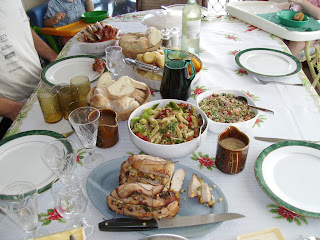.jpg) The requisite ham is yet to be brought to the table (I'm not someone who progresses from ham lover to groaning 'no more' a couple of days after Christmas - I love the stuff and miss it throughout the year!). Foregrounded is a surprisingly successful stuffed turkey breast. The plan was to butterfly it, stuff it, then roll up it up in a roulade, courtesy of a Terry Durack recipe. The carving didn't go to plan, however, so instead I made the ultimate club sandwich, sans bread. The stuffing was a milieu of what took my fancy: breadcrumbs, an egg, grilled apple, apricots, parsley, rosemary, oregano and onion. Roasted for an hour it came up an absolute treat.
The requisite ham is yet to be brought to the table (I'm not someone who progresses from ham lover to groaning 'no more' a couple of days after Christmas - I love the stuff and miss it throughout the year!). Foregrounded is a surprisingly successful stuffed turkey breast. The plan was to butterfly it, stuff it, then roll up it up in a roulade, courtesy of a Terry Durack recipe. The carving didn't go to plan, however, so instead I made the ultimate club sandwich, sans bread. The stuffing was a milieu of what took my fancy: breadcrumbs, an egg, grilled apple, apricots, parsley, rosemary, oregano and onion. Roasted for an hour it came up an absolute treat.
Immediately behind is the pasta salad, based on last year's recipe: penne, avocado, sundried toms, rocket, red caps and lashings of basil pesto. To the left, superb homemade (from scratch) bread courtesy of my sister. She also did wonderful things for dessert, with her signature lemon meringue pie. Behind the carafe of de Bortoli red are roasted spuds and pumpkins and the roast pork with excellent crackling, impressively prepared by my brother-in-law. There's also tabouleh, carrots marinated with lemon and cumin, and beans with almonds, lemon and fetta. For condiments, homemade apple sauce and gravy. Here's my first course: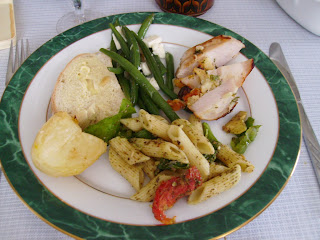.jpg)
As with all good celebratory meals it didn't stop there. SG's contribution came with dessert. He's a dab hand with meringues and this year branched out to go the full pavlova.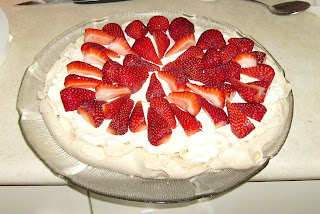
Merry Christmas! How good does that look? And it tasted as divine, with wonderful meringue crispiness surrounding a gooey interior. To end the day, there was happily some port to hand, as well as the port glasses gifted to my parents at their wedding, and which once held my first ever approved alcoholic drink.
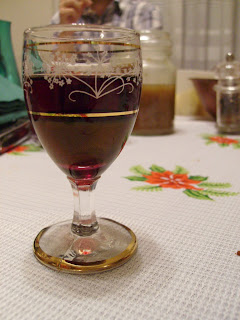
Afterwards, as tradition dictates, it was time to turn in, contentedly stuffed, at an unreasonably early hour and get up on Boxing Day to do it all again.
19 December, 2007
Flavour combo
My sage plant was looking a little stretched, a little dry towards the roots and definitely in need of a trim. What to use the trimmed leaves for? A risotto recipe happily cropped up that also gave me the opportunity of using up some sweet potato that had been loitering in the crisper.
Sweet potato is a favourite veg of mine. It's filling and versatile like potato, but has two great advantages over its cousin: it's quicker to cook and has a sweetness that lifts a savoury dish.
For the risotto I lavishly poured olive oil into the pan (we don't want the rice drying out!) along with some butter, and fried up an onion. Arborio rice was next, with plenty of stirring to make sure it was coated by the oil. Next, mushrooms and sweet pot. I'd held back on the mushrooms so they didn't soak up all the butter before the rice was added. Sweet pot's first advantage came to the fore here: it could just be added for a quick fry and then boil up as the stock was being ladled in, rather than having to be cooked separately. Pre-prepared, homemade stock was added regularly, along with a splash of verjuice (in the absence of any open white wine). When the stock was exhausted I added a good handful of torn sage leaves. For serving, I sprinkled chopped bacon, fried to crispiness, over the top, along with a couple of whole sage leaves.
How does one describe the taste of sage? It's a sweet herb; its furry leaves make me think of a peach and its that kind of sweetness it exhibits: sweet like a peach, rather than an apple or a mango. It has quite a heady, perfumed smell as well, that rises from the food. So in this dish, the heady sage marries with the starchy sweet potato and the two are countered and lifted by the salty bacon. Delish!
05 December, 2007
Home satisfaction
I've got the hang of remembering to, firstly, take my camera to restaurants and, secondly, to then photograph the food (preferably before I start eating, but this isn't always the case!) I need to train myself now in the same skills for home cooking, just in case it turns out to be newsworthy.
Saturday night's veal saltimbocca was a case in point: two strips of veal, pummelled to tenderness, wrapped around sage and proscuitto and fried each side were ladled with our best garlic, butter and white wine sauce to date. They disappeared way too quickly for photography to have come into the equation, however!
Today's lunch tasted almost impossibly good, given the ease of preparation. I just toasted a bun, grabbed some basil from the plant and smushed it with garlic, pinenuts, oil, S&P to make my signature pesto, then mixed in some whole egg mayo and smothered that all over said toasted bread with a fried chicken breast. It was su-poib.
15 November, 2007
Risi e bisi
This is a big favourite to cook at the moment - I want to say very springy, but by that I'm referring to the season, not the texture! It's loosely based on the Venetian dish that falls halfway between a risotto and a soup. My version is simply to fry onion and bacon in olive oil, then add arborio rice and a bay leaf and get the rice well covered with the oil. Add stock (or just water) and bubble away until the rice is cooked - you can have it as moist as you like. Then throw in frozen (or fresh) peas and, because I'm addicted to them, some broad beans and cook for a couple more minutes. Season and add parmesan and head to the balcony to enjoy!
A variation is to cook whichever legume you've chosen (sugar snap pea, broad bean etc) separately and then puree half, with some cooking liquid, and stir that in with the rice. A bit of mint goes nicely as well.
07 November, 2007
Cup of Content
It's Melbourne Cup Day (to me the most random of Australian public holidays), the weather is divine, and we need to fill up well at brekkie in preparation for 11am Bellinis and a long wait til the free pub BBQ at 2pm. Et voila, pancakes!
I've achieved some fluffiness through the addition of soda water to the batter, and also by letting it stand while I jogged (hah!) to the service station for a paper. Atop the stack, and melting enticingly in the sun, is homemade banana honeycomb ice cream. There's berries, there's maple syrup, there's lemon...and there's a whole lot of happiness!
19 April, 2006
Dinner at Katharina's

Eva brought marinated chicken; Jackie contributed bread with salmon or meat. Thanks to Les we had quiche. I took zucchini fritters that I had cooked that morning. They didn’t seem like much, so I also prepared homemade pesto mayonnaise. From Anthony came crackers and dips. We also had salad and, therefore, a balanced meal.


The men provided wine (very important!) and Katharina (our teacher and host) the effort of making warm everything that was cold. She also made sure a trivet sat between the table and each hot plate. The soon-to-marry Robin chose Miles Davis for music. Unfortunately Kris couldn’t be there but, as always, she sent her representatives along.


For dessert Katharina was super. Raspberry clafoutis, freshly baked.

Or, more interesting, quickly spun:
 Together, we spent a genuinely enjoyable, civilised evening.

