20 November, 2007

'The Curious Incident of the Dog in the Night-Time', Mark Haddon

Published in 2003, this book received very positive reviews from many sources, as well as the Whitbread Book of the Year (which disturbingly is now the Costa Book Award, as in the British coffee chain). It is principally an interior monologue of a 15-year-old boy with Aspergers Syndrome, Christopher Boone. The power of the book is in the factual way Christopher relates all of his story: from his genius level understanding of mathematics, his determination to solve the 'curious incident' of the title, and most strikingly the disintegration of his parents' relationship.


Conventionally society regards people with a mental disability as hindered in pursuing an ephemerally 'normal' life. Here however, entirely without preaching or didactic effort to educate, the people who aren't succeeding are the able-minded and able-bodied adults that Christopher encounters. In their version of the world everything is confused by emotions and expectations. In Christopher's as long as the different foods on his plate don't touch and he can avoid brown and yellow then life can progress quite adequately.

There are several provoking observations, which form the substance of the novel, rather than an intriguing story. I was most taken with the following digression on the notion of time:

"Because time is not like space. And when you put something down somewhere...you can have a map in your head to tell you where you have left it...And a timetable is a map of time, except that if you don't have a timetable time is not there...Because time is only the relationship between the way different thing change...and it isn't a fixed relationship."

Positive growth

"They say the seeds of what we will do are in all of us, but it always seemed to me that in those who make jokes in life the seeds are covered with better soil and with a higher grade of manure."

Ernest Hemingway

18 November, 2007

Pierogi, Polish Festival

Would you spend an hour in a queue for these tasty morsels?

In the normal run of things I wouldn't, but in homage to the way Melbourne embraces her cultural events, I was happy to get my dose of 30+C sun hanging about at the Polish Festival at Fed Square in the line for the only stall dishing up the pierogi (Polish dumplings).

And they did live up to expectation. The dough was quite thick, but very giving, and slightly salty. This was a good seasoning match to the meat filling, made a little bit peppery by shredded cabbage. On top are some caramelised onions contrasting all the mushy stuff with some crunch. Especially given the Albion Polish Association must have sold several thousand of these on the day, they were a quality, fresh product.

There was also plenty of this fine Polish pilsener, Okocim, to be had!

Sippers

164 Rathdowne St, Carlton; 9348 2808 now closed

Sippers specialises in stocking wines and beers from smaller producers, as well as sourcing the ingredients for their extensive tapas menu from local suppliers. It's a very commendable aim (though for the drinks 'small' doesn't necessarily equate to 'local'). The downstairs bar space features lots of dark wood panelling, red velvet couches, gilt mirrors and barrels with stools. Footpath and upstairs dining are also available.

The Sippers menu is divided into tapas and tascas. The latter actually means 'bar' in Spanish, but as Sippers explain on their website, their tascas are their smaller portions (though prices are fairly similar), so perhaps they mean them as bar snacks. In any case, tapas actually derives from the Spanish for 'lid', and there are few venues outside Spain (indeed, outside Andalucia) that actually serve genuine tapas, rather than just small portions of 'themed' food.

There are some great beers on offer - St Arnou on tap, Hargreaves Hill, Red Hill and a raspberry ale. I tried a Yarra Valley Gewurztraminer, which was a little on the straightforward, fruity side. Excited by the food menu, we picked our top four plates, but decided to stagger the order, to save over-ordering. First up was calamari and octopus in besan flour and tomato jam (not sure why they use the Indian name for chickpea flour, rather than the Spanish, gabanzo).
The octopus was particularly tasty and had retained good texture and the calamari was giving rather than chewy. I thought the chutneyish tomato jam was the wrong flavour match for seafood.
Just as well the food tasted good, since we had waited an hour for it to come out. We were regretting our decision to stagger, and were quite bemused that tapas - ie small, lightly cooked portions - could possibly take that long to prepare.
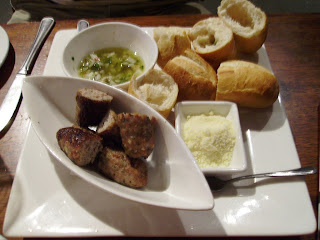
The second dish we'd ordered was pork sausage with chimichurra (a South American sauce of oil, parsley, garlic and lemon). Points for innovation with this dish: I love a make-your-own restaurant dish. In this case one puts some chimichurra in the hollowed-out breadroll, sprinkles some parmesan around, then wedges the sausage on top. The pork sausages were dense and meaty and while parmesan may seem an odd addition the whole combination worked very well.
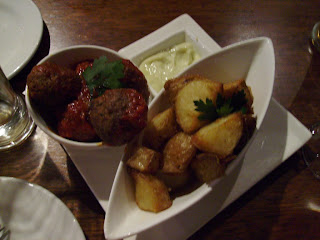
During our interminable wait for food we'd decided not to order Round 2 in protest, however we were quite impressed with what was eventually served up. So we ordered again, this time lamb and rosemary meatballs and patatas bravas.

They hadn't been shy with the rosemary and it complemented the softly cooked lamb wonderfully to make a richly flavoured dish. The potatoes were spot on, crispy and salty with a curiously green, gratifyingly garlicky aioli.
There were many other dishes we could have chosen, and they do have banquet options that would satiate a fierce hunger. The wait on the food though was really inexcusable and removed the option for us to pace our way through a tantalising menu, which is how good sharing food should be enjoyed.

15 November, 2007

Risi e bisi

This is a big favourite to cook at the moment - I want to say very springy, but by that I'm referring to the season, not the texture!

It's loosely based on the Venetian dish that falls halfway between a risotto and a soup. My version is simply to fry onion and bacon in olive oil, then add arborio rice and a bay leaf and get the rice well covered with the oil. Add stock (or just water) and bubble away until the rice is cooked - you can have it as moist as you like. Then throw in frozen (or fresh) peas and, because I'm addicted to them, some broad beans and cook for a couple more minutes. Season and add parmesan and head to the balcony to enjoy!

A variation is to cook whichever legume you've chosen (sugar snap pea, broad bean etc) separately and then puree half, with some cooking liquid, and stir that in with the rice. A bit of mint goes nicely as well.

13 November, 2007

Spuntino Bar, T'Gallant Winery

1385 Mornington Flinders Rd, Main Ridge; 03 5989 6565

If you had to pick a day to head down the Peninsula, purely to augment one's wine supply, this was the day to go. Flooded with sunshine, but too early in the season for the un-ac'ed Pulsar to get uncomfortably hot. Definitely the weather for sundresses, suncream, and sun-drenched lunches!

T'Gallant has an excellent cellar door, with a lot of wines on tasting (including four of their white pinots: makes for a great comparison between the French and Italian styles) and two eating establishments on site: La Barracca Trattoria and Spuntino Bar, which does a simple line of finger food and desserts.

Spuntino has three pizzas on offer, served as half or full. 'Half' refers neither to a semicircle of pizza, nor a mini-disc, rather 12 squares served on a wooden board - a tidy snack for two, whereas a full pizza would provide a more than adequate meal. We went for the salsiccia, with salami, sugo and pecorino.
Foregrounded is a bowl of roasted, herbed potatoes, that we ordered assuming half a pizza wouldn't be enough. Phew, that's a whole lot of carb! And oil - the pizza was smothered with it, pooled into the curled-up salamis. Once the oil was sponged off the salami provided the chewiness, while the base and pecorino where a soft, giving counterpoint. Very moist and very moreish. The spuds were flecked with sea salt and had been scored for extra crispiness.
There's a great view too, over pinot vines that run up and down sloping hills. Next to the wooden trestle tables is part of the winemaking facility, which gives a nice visual flowchart from vine, processing, to the finished product ready to be tasted at the cellar door.

12 November, 2007

'Spain by the Horns', Tim Elliott

This example has been on my 'to read' list for years - although I don't remember the original source, given my predisposition for all things Spanish it wasn't a surprising entry - but I was so disappointed by it. It had the feel of a book written as an afterthought - the author went travelling, recorded their notable experiences, then decided to write a book about it. This one, however, was pre-planned and the author has a writing background as well, so I was surprised at how it came together.

Tim Elliott's interest was piqued by tales of JesulĂ­n, a hugely famous Spanish bullfighter. Elliott travels to Spain to track him down, leaving a wife and two-month-old baby behind. His search is routinely thwarted and the book records his issues from Madrid to various towns in Andalucia.

My big, big problem with this book was similes. They were frequent, and frequently terrible, if not nonsensical. Some standouts were: horses with "satiny flanks glowing like copper" (apples and oranges, anyone?), "bald as bathing caps" and sweaty armpits like "burning swamps". They littered the text as if by decree - add more similes! To wander Madrid shortly after arrival "like a jetlagged zombie" doesn't need literary trickery to get across the meaning. Stars that shone "pincer sharp" sounded more like primary-school writing. And when some elderly people were "leaking sadnes like invisible ink", I confess I didn't even know what the imagery was meant to add to the description.

Further, I often found notes of condescension in the book: sardonically referring to the bullfighting publications of a Spanish academic as "a bit of light reading", or to the translators of a thousand years ago as "bookish little men". The second adjective there is really uncalled for.

The author is fluent in Spanish, which opens up a lot more interviewing opportunities for him. There are some frustratingly banal translations included, however. For example, a bar called Casa Alberto is superfluously translated as "Albert's House". Commendably, Elliott does make a genuine effort to include historical details, not only of bullfighting but also the towns he visits, as well as informative excerpts on Spanish history. It is in these factual sections where the better writing is to be found, perhaps reflecting Elliott's past in journalism. And he does give an evocative and accurate rendition of Andalucia, while acknowledging that it is its own stereotype, rather than that for all of Spain.

09 November, 2007

Golden Pizza

500 Lygon St, Brunswick East; 03 9383 1386

Despite its proximity, it's taken me almost two years to get around to sampling Golden Pizza. It's further away than il Carusi and, while closer, doesn't have the trattoria ambience of La Bussola.

They have a blackboard range of standards - variations on ham, olives, salami, mushroom, starting from around $7 for a small or $9-10 for a medium. More exciting are their specials, revolving around more tantalising ingredients such as basil, artichokes and sundried tomatoes. These start at $11 for a medium.

I went for Julie's Margherita:Lots of big torn basil leaves, heavy with luminous white ricotta and dotted around with halved cherry tomatoes. Good, fresh flavours, though perhaps slightly cloying on the ricotta - combined with the thicker base - and mainly because I've eaten so many wafer thin, crispy bases of late - it was a little chewy. The dough was excellent though: firm, but came apart well and ever so slightly sweet.

Update: Golden Pizza have moved across the road to 465 Lygon St, Brunswick East. Their phone number is the same.