I've got the hang of remembering to, firstly, take my camera to restaurants and, secondly, to then photograph the food (preferably before I start eating, but this isn't always the case!) I need to train myself now in the same skills for home cooking, just in case it turns out to be newsworthy.
Saturday night's veal saltimbocca was a case in point: two strips of veal, pummelled to tenderness, wrapped around sage and proscuitto and fried each side were ladled with our best garlic, butter and white wine sauce to date. They disappeared way too quickly for photography to have come into the equation, however!
Today's lunch tasted almost impossibly good, given the ease of preparation. I just toasted a bun, grabbed some basil from the plant and smushed it with garlic, pinenuts, oil, S&P to make my signature pesto, then mixed in some whole egg mayo and smothered that all over said toasted bread with a fried chicken breast. It was su-poib.
05 December, 2007
Home satisfaction


04 December, 2007
'The Secret River', Kate Grenville
 Of recently-released fiction, this was the novel I was most keen to read. It was Australian, it dealt with history, it was from an admired publishing house (Text) and it had been decorated with multiple awards. Such a build-up can lead to disappointment, but I don't think it was my expectations that gave me a confused response to this book.
03 December, 2007
La Bussola
319 Lygon St, Brunswick; 03 9387 6779
 In an earlier post I commented on Il Nostro Posto's attempts to create a genuine Italian trattoria feel, which I didn't feel were a 100% successful. In part, that was probably because I was subconsciously comparing it with La Bussola, the first restaurant we ventured to in the area and have since returned to probably more than any other. Why? Because this family-run establishment turns out well-priced, generously-portioned, authentically-prepared Italian food. Furthermore, the interior makes me feel like I'm in Italy: elaborate wrought iron contrasts with laminex tables and plastic chairs. The walls at the front of the restaurant are exposed brick; at the back they're a colour-wall of various warm hues being tried on for size.

La Bussola also does good things on their drinks list. They offer house red and white at just $4 a glass, as well as several beers at good prices. Even Peroni comes in at $5 a bottle, I think.
 It arrives steaming from the pizza oven and is suitably laden with toppings. While I'd never use it at home, I love a trattoria pizza strewn with diced ham. The pizzas are only lightly cooked, but the dough still achieves the crispiness you want to complement the toppings moored in the melted cheese. Excellent value, fresh, quality stuff.
29 November, 2007
Mark's Pizza
Corner of Grattan and Swanston Sts; 03 9347 0474
Mark's is a great option for a cheap feed, close to the CBD. Most of the pizzas are around $8-9 for a medium size (example below).  There's a set menu of course (with selected extras, including chilli and parmesan, at no extra charge), the option to create your own, as well as blackboard specials. The set menu is quite generic - margherita, capricciosa, that curious entity that is the 'Aussie' pizza - but the specials branch out a lot more, with options such as tangy satay chicken. There is also a limited range of pasta dishes, and gelato is available for dessert. The wine list is brief and cheap - mainly Rosemount and Lindeman style wines.
The pizzas have quite a thick base, which was a little on the doughy side. It could just be because I'm so used to the thinner style, but with the cheese cooked almost to crispiness, it was a bit of an inbalance. The toppings are generous, but the heavier dough overwhelms them a bit so each doesn't stand out individually. Regardless, the pizzas are freshly and attentively made; are far, far superior to franchise pizza; and they are served by genuinely cheery staff.
28 November, 2007
'On Chesil Beach', Ian McEwan
 Much has been written about Ian McEwan's latest, published this year, principally that it is a) very short (in my version 166 pages), b) that it didn't win the Booker Prize and c) whether or not its premise and resolution are plausible.
Briefly, the novella commences with a virginal British couple in their early twenties, Edward and Florence, at a hotel in Dorset on their wedding night. It is 1962, 'a time when a conversation about sexual difficulties was plainly impossible'. The book recounts how they met, touches on their families' backgrounds and returns between each digression to their awkward hotel suite. It is not a plot of action, rather a dual character study, irremovable from the time period. As Edward says, as they finally reach the pure white bed, the only things standing in their way are 'the tail end of religious prohibition, their Englishness and class, and history itself. Nothing much at all'.
The book is short on dialogue, long on description, characterisation and observation. With its length, it is best appreciated in a single sitting - set aside a time and go cover to cover, allowing a cohesive reading that gels the key events, telling background and unforeseen outcome.
Sex is of course a key theme of the novella, but it is played out around the main characters, rather than by them. An extraordinary paragraph on just the third page involves the Dorset flora in a dumbplay of consummation. Florence, as a violinist, is given her passionate outlet through performance. The bias of perspective in the novella falls to Edward, which I found a little isolating, until on second read I noticed more closely the language used to describe Florence's playing.
There is an enormous amount squeezed into these 160-odd pages: two lifetimes and an entire conservative national culture at its cusp before the sexual revolution. The sweep of emotions and concepts is contrasted with the sharpness of the couple's final conversation in Part Five. It's a dramatic change and I think that making the jump with the author is the hardest task for the reader. Previously the novel has relied almost entirely on observation; the majority of that in hindsight. Now we face a conversation where the participants say none of the things they mean, but inform the audience through their interior monologues of what their counterpart cannot know. This exchange is the early 1960s: an educated man and woman unable to express themselves about intimacies, when they can, and are expected to, comment on the Soviet Union or identify birds by their song.
26 November, 2007

22 November, 2007
Lyrical romantic

21 November, 2007
il Nostro Posto
60 Hardware Lane, Melbourne; 03 9670 9939
Hardware Lane is an unusual part of Melbourne. Diners accustomed to blithely opening unmarked doors, scurrying down hidden staircases and striding fearlessly along laneways to reach fabled restaraunts are, in this part of town, suddenly confronted by maitre d's making themselves, and the restuarant, as conspicuous as possible. There are some pretty extensive menus being proffered, but we elected to go with a restaurant that, with a more succinct menu, could perhaps dedicate themselves to turning out a select ion of very good dishes, rather than pages' worth of OK ones.
Housed in an old warehouse, il Nostro Posto aims for an authentic trattoria feel: framed 'Roman Holiday' prints on the wall; banter in Italian between the staff; and a specials board with Fileto di Manzo and Cotoletta di Vitello. Something in the bright lighting, or the dark wood finish meant the effect didn't quite hit the mark for me.
The wine list is certainly a helper towards the authentic Italian vibe. On our waiter's advice we drank a newly-arrived Sicilian white from the Rallo vineyard. Very dry mouth feel, but with an equally fruity palate.
My main was risotto di carciofi e prosciutto, interestingly presented:
After my recent wranglings with whole artichokes I had great admiration for this well-sized, entirely intact and deliciously steamed/boiled specimen. I was also able to mix the leaves in or savour their nutty flavour alone as it pleased me. The risotto had good consistency and wasn't over-salted. I'd seen a cook carrying tubs of stock through the restaurant, which in my imagination had been ladled out of an ancient, hundred-litre bubbling copper vat in the cellar!
The 'burning finger' lamb cutlets are named from the Italian term indicating that they're eaten hot from the pan with your hands. Again, very visually pleasing. The lamb was thick- cut and well-cooked - juicy pink in the middle. Crisp beans, creamy mash and plenty of soaking gravy...our location may not have epitomised Melbourne but the weather, which had dropped 15 or so degrees in the day and brought plenty of cold rain, certainly did and this dish - part BBQ favourite, part winter-warmer - fitted the conditions perfectly.
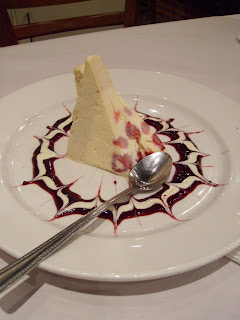
Dessert featured a housemade tiramisu, a dish in which the total should be greater than the sum of its parts. The parts were fine: rich cream, studded with coffee beans, and lots of moist sponge fingers. Unfortunately most of the coffee drenching had dropped to the bottom of the cup, so it was a bit like attacking a drink that you haven't stirred with spoon, and hitting all the gunk at the bottom. Regardless, it was undoubtedly fresh and very enjoyable. Lastly, a picture-perfect fruits of the forest semi-freddo brought together sweet and creamy wedges with a delightfully tart coulis - sensational flavour combinations.