My sage plant was looking a little stretched, a little dry towards the roots and definitely in need of a trim. What to use the trimmed leaves for? A risotto recipe happily cropped up that also gave me the opportunity of using up some sweet potato that had been loitering in the crisper.
Sweet potato is a favourite veg of mine. It's filling and versatile like potato, but has two great advantages over its cousin: it's quicker to cook and has a sweetness that lifts a savoury dish.
For the risotto I lavishly poured olive oil into the pan (we don't want the rice drying out!) along with some butter, and fried up an onion. Arborio rice was next, with plenty of stirring to make sure it was coated by the oil. Next, mushrooms and sweet pot. I'd held back on the mushrooms so they didn't soak up all the butter before the rice was added. Sweet pot's first advantage came to the fore here: it could just be added for a quick fry and then boil up as the stock was being ladled in, rather than having to be cooked separately. Pre-prepared, homemade stock was added regularly, along with a splash of verjuice (in the absence of any open white wine). When the stock was exhausted I added a good handful of torn sage leaves. For serving, I sprinkled chopped bacon, fried to crispiness, over the top, along with a couple of whole sage leaves.
How does one describe the taste of sage? It's a sweet herb; its furry leaves make me think of a peach and its that kind of sweetness it exhibits: sweet like a peach, rather than an apple or a mango. It has quite a heady, perfumed smell as well, that rises from the food. So in this dish, the heady sage marries with the starchy sweet potato and the two are countered and lifted by the salty bacon. Delish!
19 December, 2007
Flavour combo


17 December, 2007
'31 Songs' - Nick Hornby
 When you've set the benchmark for a modern genre, it seems reasonable to publish a book of your personal digressions on a topic integral to your novelistic style. In Nick Hornby's case, that topic is popular culture, or more specifically in this case, pop music. Here are 31 songs that mean more than just a bit, songs that have defined moments but, more than that, have stayed with Hornby over time and have often transformed to take on new meanings. His musical knowledge is aptly demonstrated. He is a man who listens on many levels, hearing the subtlety in pop music that one reads into literature or looks for in art.
Right from the start, this isn't a concept that is going to please everyone. In 'High Fidelity' each of Rob's Top 5 lists is laid out there in a fictional context: just like his record-shop mates the reader is free to criticise or nod sagely in agreement. Here though, Hornby is putting his favourites out in the real world. There's no fantasy or other characters to hide behind. And, if you have never had a relationship with a song that lasted longer than its three-and-a-half minute duration, then the book's appeal would be lost to you by the time you're halfway through the introduction.
If, however, your record collection has played a significant role in your emotional development, then there's always the problem of personal taste. I hit my first taste obstacle with just the third song of the book and my immediate response was, momentarily, to wonder how I could go further and trust the taste of a man publicly proclaiming his satisfaction with this particular songstress (granted, with only one specific song of hers). Such disagreements are inevitable, but are also in fact part of the point that Hornby is trying to make. These songs are about him: he is relating his inner self and experiences through what these songs mean to him, rather than using up his, his publisher's and the reader's time simply expounding on what he likes. It's not the choice of songs that are most relevant, it's what Hornby reveals about himself in describing why each song is included. That level of honesty and philosophy, combined with his music knowledge, make this a worthwhile exploration.
15 December, 2007
Pappa's Fish and Chips
79 Holmes St, Brunswick; 03 9383 4331
What's a hot summer Friday night without fish and chips? When you've no mood to cook and, let's face it, the house is already too hot without turning on the stove and oven (there's nothing in the house that could be prepared via use of the microwave alone) the local fish and chippery is a happy haven.
We're blessed to have some of the best value fried seafood and starch in Melbourne very close to hand. How much would you expect the serving shown below to set you back? To help you guess, included is a piece of fish too large to fit the box, two potato cakes, a dim sim, and more chips than we could ever eat and retain healthy heart function.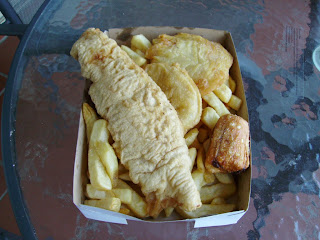 $7.70*. That's right. And if that makes you shake your head in wonder let me add to your incredulity: this is what they call the Single Pack! (Oh yes, and it comes with a can of soft drink as well).
The fish is plentiful. As you can see from the picture it comes in a pale batter and probably tastes best immediately out of the oil: it doesn't tend to be particularly crispy by the time you get it home. That's OK though because the ratio of fish to batter is very much in favour of the flesh. The potato cakes are hefty as well, with a wonderful crunch to the batter. And the chips are good enough that I always eat way more than I needed to, normally at the expense of the poor dim sim (excellent with soy sauce).
*The 2008 price is $9. Still good value :)
13 December, 2007
'Once While Travelling' - Tony and Maureen Wheeler
 This is the history of the publishing giant that is Lonely Planet. Now over 30 years old, the company progressed slowly enough towards its current status that this book is primarily concerned with developments, experiments, trial and error: their global success was not cemented until the last third of their history.
Its strength lies in its multi-level appeal. Nearly anyone who has travelled has used a Lonely Planet guide and it's fascinating to learn both how the company grew and to get to know the people who started it. There is a strong business element to the book: it is both inspiring and informative as for the first 15 years or so this was a very small, personal operation. There are also a lot of travel tales, from the Wheeler's utterly exhaustive trips around the world, with descriptions and anecdotes from every continent. Furthermore, Tony and Maureen Wheeler are extremely endearing people so the biography element of the book is just as engaging as the business and travel aspects.
Having read multiple large-print-run works of literature of late with typos and inconsistencies it was a relief to read something so well edited. This is not entirely surprising, since Tony managed the publishing side of Lonely Planet for many years and is an experienced editor. That's not to say it's flawless - there are some overly colloquial sentences that are hard to interpret on the first read and hence appear as mistakes, and the chronology does jump a little bit. This is inevitable though and does not lessen the reading experience: in business the consequences of one decision may not be felt for several years, so on various occasions an event is initially summarised and then explained more fully at the appropriate stage later in the book.
What is so endearing about this book is its truth. The Wheelers must have been asked thousands of times how Lonely Planet started and grew, and here they have a reference that allows them to say 'If you really want to know, read this!'. Importantly it gives a clear idea of how the business grew (and at times retreated), without miring in too much detail, rather than leapfrogging from success to success. It doesn't skirt around hard times or bad decisions. Having bought my first Lonely Planet in 2003 I was intrigued to learn that it was at this time, with profits in eight figures, that the company went through some of its hardest times.
The account is neither verbose, self-indulgent, nor contrarily self-effacing. The company is a global brand and it would ring falsely if the authors pretended it was anything other than that. While not ignoring the extent of their success, the more detailed chapters focus on the development of the company, during which the Wheeler's knew everyone who worked for them and celebrated every staff member's birthday, a tradition I have no doubt they would carry on if their size allowed.
11 December, 2007
Animal Orchestra
163 Grattan St, Carlton; 03 9349 4944 Located close to Melbourne University, Animal Orchestra does a good service to its staff and students, serving up a variety of pides, daily specials and all-day breakfast.
Handy too, at this time of year, that it's ample footpath seating gives options of sunny or shady, in addition to the tables inside. For those avoiding both sun and wind there is an extremely cosy interior: low lighting is offset by brightly collaged walls and lots of mirrors.
The all-day breakfast features a range of baked eggs, with meaty and vegie options. There are also three daily soups ($9.90). The cafe is licenced and offers a range of teas, including their own mint tea.
The best student fare are the pides, priced between $8.80 and $9.90. There are seven on offer, including chicken with bacon, thyme and pesto mayo and cheese, as well as Viet-pork with veg and hoi-sin sauce. The mushroom pide comes with chilli, garlic (great start to an ingredients list), roast almonds and fontina cheese. (For the sake of customer expectation I would call this a focaccia, or even toasted sandwich, but I'm assuming they're using Turkish bread, and hence the 'pide' moniker). The mushroom pide had visible chopped chilli but its flavour came overwhelmingly from the funghi, rather than the accompaniments.
Animal Orchestra is in a great spot: relatively quiet, although within a spit of Swanston St, and is guaranteed a good passing trade from the Uni. It's also a far preferable alternative to the two franchise outlets visible from its footpath seating. For a post-lecture drink, or quiet study inside over freshly-brewed tea it achieves good marks.
Sunlit dust
 "If you're fortunate, the thread of meaning that is said to run through personal existence eventually breaks and the coherent story of a life that might have looked good in a book or newspaper obituary becomes instead the floating of glowing dust particles in a beautiful shaft of sunlight called consciousness.
I'm beginning to think that a good life has a very pleasing lack of story line and a lot of sunlit dust particles"
Michael Leunig
10 December, 2007
Pizza Farro II
608 High St, Thornbury; 03 9484 2040
 What to do when a multi-page menu has no dull bits, no sections to skip over before you get to the good stuff? Pizza Farro's current menu is temptation from the off, with the front page pasta specials - such as spicy pork sausage in a carbonara sauce - almost luring me away from my dining intention: their excellent, spelt-flour pizzas.
 What a list! It's a superb flavour and texture combination, as the salty tapenade layering the pizza base is perfectly countered by the sweet, fluffy ricotta. The pine nuts add a tiny bit of crunch and the artichokes give some roughage, in a good way, against the downy cheese.
 It delivers on the flavour promise, though all that meat, dough, greenery and cheese shaved on post-oven had my mind tricked into thinking focaccia rather than pizza.
 tumblers as the water. The waitstaff are keen to help you with the menu, make recommendations and ensure you're aware of any updates since your last visit. A word on corkage though - we were last there in May and the corkage was $3.50 and in our case was actually $0, as they waived it since we hadn't finished the bottle. Last night corkage was $7 a bottle, about the same price as their cheapest by-the-glass. It seems out of keeping with the rustic atmosphere.
06 December, 2007
Rathdowne Tavern
184 Rathdowne St, Carlton; 03 9348 1133

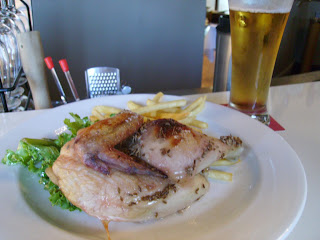
For $10, including a pot, a convivial atmosphere of customers happy with quality food at a great price, and friendly bar staff, it represents excellent value.


