Level 2, QV Square (cnr Swanston and Lonsdale Sts); 03 9650 2325
It’s not breaking any new ground to eat at, or indeed review, a Wagamama restaurant. I did find our recent dining experience there interesting, however, for what it demonstrated about the food journey both the restaurant and I have travelled since we first became acquainted.
The first Wagamama I came across was in Covent Garden, London, and from that first encounter something in their cheeky menu and underground, brightly-lit space had big appeal. I ate there several times in London and Guildford. A few years ago Wagamama were ostensibly too mass-consumerist for my taste, with new restaurants popping up with the regularity of big-chain coffee houses. But their food was innovative, fresh and well-priced, commodities that are exceedingly hard to come by in England.
I’ve eaten there a couple of times in Australia and the biggest difference I’d noted was the absence of my favourite dish, the chicken chilli men: soft Hokkein noodles interlaced with diced chicken and crisp vegetables such as snow peas and capsicum, heightened by a good breath of chilli.
Before ordering on our most recent visit, SG did question whether I’d be alright, ‘eating at a franchise’. I assured him I’d be fine: I’d eaten here loads of time, always enjoyed it and had made my way through most of the menu, from ramen to yaki soba to the katsu curry, both vegetarian and meat.
First to the table was a tray of five duck gyoza, with a very thick, sticky soy sauce. The filling was lovely: lightly steamed meat and some spring onion crunch. The pastry, however, was very poor: more like a biscuit, crunchy and noticeably browned.
SG stuck with his staple, the chicken ramen.
A relatively clear broth, plenty of sliced chicken, stocky noodles and some green for roughage. It's a heartening dish, but...I'll come back to that.
I went with a new dish, the spicy chicken itame, with mint, basil, coriander and garlic. The chicken had wallowed in ginger and the red onion lent a caramelised flavour to the rice. It looked a treat in the bowl, with chunky zucchini and broccoli pieces crowning the rice. (And it was hot, more than could be said for our green tea). The chicken, however, was far too dry. The dish was seriously spicy; probably not too hot for a real chilli lover, but significantly spicier than anything I’d experienced at Wagamamas before. Although the vegetables had looked impressive and abundant, there were serious filling-to-rice ratio issues: the former ran out long before the latter.
While Wagamama may not quite be soul food, they have always preached a vibrant and positive food philosophy. These dishes didn't give me a good food buzz though, nor did the service. After eating I felt uncomfortably full, overly salted and like I’d eaten…well, franchise food. The ramen was perfectly adequate, but I don't necessarily want a dish I haven't tried for a couple of years to taste exactly like it did last time I had it, especially when that last time was in a different country!
I don’t know if it’s just that my tastes have changed and refined, or if in keeping Wagamama afloat they’ve started to cut a lot more corners in the kitchen. Certainly the company had to close down its St Kilda store last year, not that long after opening in Melbourne Central. Their expansion into Australia has never been as rampant as it was in Europe. When you’ve got Don Don across the road doing wok-to-bowl food for $6, and Cookie down the street serving up very credible curry, you need more than cute branding to keep it pumping.
01 February, 2008
Wagamama


28 January, 2008
Australia Day BBQ
Hm, now this is a food and book blog, so it's not the forum for me to discuss my opinions on Australia Day. However I feel that I have to clarify that this was not an 'Australia Day BBQ', rather a BBQ that happened to be held on that day, which was significant and worth naming in order to set the tone - that long weekend vibe that often gives rise to urges to grill. Spectacular weather along with excellent, fresh, well-priced food seemed as good a thing as any about Australia to celebrate.
But to the food. For me, when it comes to barbecueing, I concur that meat is an essential, and that it can be provided from a range of animals and in a range of colours and formations, however what I consider a given on any barbie where I'll be holding the tongs is potatoes. Very finely sliced, liberally oiled and with generous amounts of sea salt and rosemary distributed atop. They're normally my BBQ vegetable staple, but since we were going all out, I even prepared a wee salad, of spinach, red capsicum, snow peas, avocado and cashews.
Something had to balance out the three types of meat! The grill hosted chicken skewers with mushroom and capsicum, beef sausages, and tres skinny BBQ steaks, which took about as long to cook as it did to devour the potatoes!
Served up with a glass of Polish Hill Riesling from Randalls, bread baked that morning, and with Laharum Grove aioli as condiment of choice (it went with everything), it had me wondering momentarily why we ever cook any other way!
23 January, 2008
The Press Club
72 Flinders St, CBD; 03 9677 9677 George Calombaris has had nothing but praise and accolades since opening The Press Club in 2006. The menu is modern Greek, taking traditional ingredients and flavours of his home country but serving them in an updated style that is unique, even in this most Hellenic of cities. Where innovation is the key word in the kitchen, flexibility takes charge on the menu and in the overall setup. The venue includes a restaurant, private function room and bar. In the restaurant, diners have the choice of a la carte, kerasma - a Greek style of sharing menu - or degustation. Before being faced with that range of options, however, there is also the choice to turn right rather than left after stepping into the foyer of the former Herald building, and instead select the smaller, cheaper Bar.
The bar menu is as user-friendly as the restaurant's is expansive. The 20 or so dishes are grouped as one of three types of mezedes (which are suggested as accompaniments to wine, beer or ouzo) larger dishes or glyka (desserts). A refined list of wines by the glass is included on the bar menu, although behind the counter an enormous range of beers, spirits, ouzo and wines (including several Greek varieties) awaits. We drank a crisp, appley Chapel Hill 'Il Vescovo' Pinot Grigio at $9 a glass.
Of the 11 larger dishes on offer, I think all three of us could happily have ordered any one. Tempting as it was to sample Calombaris' take on some Greek favourites, neither the open souvlaki of the day, nor the calamari got an invite to our table. We were determined, however, that the Greek 'Parma' should get a run. Tender thigh meat, in lightly-seasoned crumb, was topped with zucchini and eggplant. Kefalograviera cheese is melted on top, giving the dish a robust saltiness, which allowed the schnitzel to be more delicately flavoured than in a more pub-style parma. It comes with fresh lemon potato.
A salad of cucumber and braised lamb perches on a bed of (lightly) minted yoghurt. The lamb neck was charred on the outside but pink and moist inside. It is perhaps one of the more traditionally Greek dishes on the menu: the triumverate of Greek flavours enhanced simply through freshness, rather than added flair.
The dark horse of the night was the pumpkin and almond bougatsa, with Byzantine grape dressing. Bougatsa is normally a sweet dish of custard served in filo pastry. Here, the custard was replaced with mashed pumpkin in a bechamel sauce, dotted with slivers of almond and a smattering of fennel. A sprinkling of icing sugar nodded to the dish's more traditional incarnation.
The bar menu is an excellent way to introduce yourself to the fine dining of The Press Club, whether you're yet to sample the main restaurant because you're short on money, or time (it's currently booked out 2 weeks in advance, up to a month on weekends). It is a bar, however: a little crowded, with lots of suits sampling the multinational drinks menu and a plasma TV in one corner. Some exact calculations have been done to match the accessible dish prices with their size: they are not stingy, but the focus is very much on quality rather than quantity, which I think is a reasonable decision when it allows you to sample The Age's Chef of the Year for as little as $15 a dish.
20 January, 2008
Antz in the Kitchen
901 High St, Thornbury; 0407 413 948
A food review without photos is like a coffee without sugar, or pasta without parmesan: the substance is there, but you're missing the extra kick that makes it memorable. It was my fault that I'd forgotten my camera, but after reluctantly employing the illogical cross-technology that is the phone camera, the accompanying software decided to 'cut' the photos off my phone, without then 'pasting' them onto my computer. Gone to the ether. Oh, the joys of technology.
Had it been a terrible cafe experience I perhaps would have cared less. But the relatively new Antz (at the Preston end of High St), while not taking any new culinary directions, is handling itself well in its chosen niche: breakfast and lunch staples, fresh juice and commendable coffee. The cafe fitout is strong on natural sunlight and primary colours. The deep blue pressed metal ceiling and red velvet bar stools give it the feel of a miniature ballroom.
The menu dances a steady waltz. Eggs - bendedict, florentine, scrambled or poached - take the floor first. Muesli and pancakes are quick to follow and shortly afterwards everyone has the chance to sit down to a range of sandwiches. The range of Antz burgers up the pace a little bit: there's the straight 'Antz' (beef pattie, lettuce and sauce), 'chickant' and 'vegant'. The ants go marching down the 'Refreshmants' board as well.
The food keeps its respectability and doesn't go off jiving to tunes it can't quite pull off. A BLT is served on a white bun with strips of iceberg, loads of bacon, a sweet mayonnaise and some unfortunately soggy tomato. The Antz burger is a thick pattie with a relish-style sauce. Most promisingly, the coffee served is of high quality, with a little-finger-thick crema and smooth taste that shows well-controlled roasting.
This is a small-scale, suburban cafe playing familiar tunes but showing good skill with its instruments.
18 January, 2008
A Minor Place
103 Albion St, Brunswick East; 03 9384 3131
One of Brunswick's shopfront cafes (cf Ray's, Small Block, La Paloma), A Minor Place offers guests milk crates and fold-out tables outside. Inside, an easterly window welcomes plenty of sunlight over the wooden communal tables as well as a few smaller seating options. It's a minimalist fitout that is netting reward: on a Wednesday lunchtime at least 20 people are seated amongst the tables. Isabelle Lucas, former Neighbours star, notes it as one of her favourite spots in an interview with the age(melbourne) magazine.
Their menu features plenty of organic produce and an imaginative take on breakfast. My menu highlight is the french toast: casalinga bread dipped in free-range eggs, served with stewed rhubarb, quality maple syrup and moreish pistachio ricotta.
Their coffee is carefully made and strong. This mocha looked too well-decorated to drink, so I photographed it to allow it to be preserved on the web, then vigorously stirred and took my time enjoying the blended tastes of bitter coffee and rich, sweet chocolate.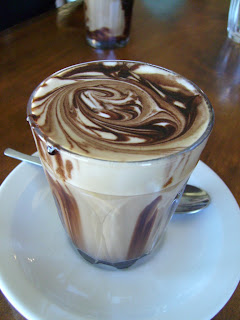
14 January, 2008
'The Unknown Terrorist' - Richard Flanagan
 This is a novel that opens brilliantly and provokingly, then maintains a compelling level of dramatic and intellectual tension. At every plot development the reader is affronted simultaneously by the idiocy of Flanagan's public, as well as the fact that in the very recognisable and believable world that Flanagan has created, such idiocy is entirely plausible.
11 January, 2008
Kake di Hatti
128 Lygon St, Brunswick East; 03 9387 7771 It's 42C outside. It's after 8 o'clock at night. Your favourite Italian place is still on holidays. Where to eat? I admit not everyone would immediately think 'curry' in these circumstances, but plenty of people obviously had, since Kake di Hatti was pumping when we gratefully stepped into its air-conned dining room.
 The meat has obviously been stewing for a suitable period of time, perhaps since the mercury peaked at 5pm or so. The sauce too has the balance and subtlety of flavour that shows it was prepared freshly but with time to mull over its contents.
 The garlic naan is exceptional: crispy bubbles from the oven, soft and chewy dough and lathered with minced garlic. Just fantastic.
08 January, 2008
'In My Skin' - Kate Holden
 Kate Holden writes a fortnightly column for The Age's A2 weekend supplement, in which her perceptiveness, intelligence and alluring grasp of English are always apparent. Her subject matter is observational, whether of Melbourne culture or affairs of the heart, and regularly provides an uplifting start to a Saturday morning. Personally, she is even more inspiring as a graduate of the writing course I'm currently undertaking, the Diploma of Professional Writing and Editing.


